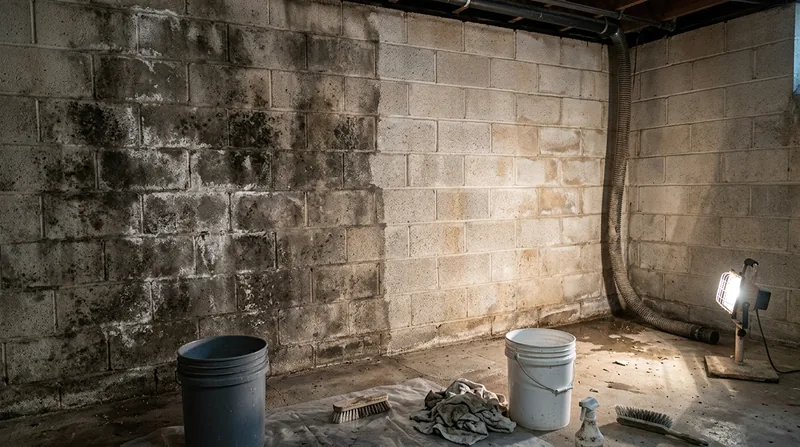


Jackson sits at the northern edge of the Pine Barrens on the sandy Coastal Plain, and that geology sets up the mold problem here. Sandy soils drain fast, but buried clay layers trap perched water against basement walls, and the high water table near the Metedeconk, the Toms River branches, and the many lakes keeps that water pushing inward. Add humid shore-country summers and heavy downpours like Ida in 2021, and the 1950s-1970s ranches around Cassville and the finished Colonials out in the western subdivisions turn into moisture traps. Our Basement Mold Remediation in Jackson pairs the removal work with the moisture fix that stops the mold from coming back, because treating the growth without killing the water source is a waste of money. We handle the musty smell diagnostics too, so you know whether you are dealing with a damp wall, a failed sump, or an active leak. If you are still sorting out the water side, start with our basement waterproofing in Jackson page.
Why Basement Mold Grows So Fast in Jackson Homes
Most of the mold calls we get in Jackson trace back to a moisture source that has been running quietly for months. A block basement in Holmansville wicks groundwater through the mortar joints. A poured wall in Bennetts Mills gets hairline cracks that weep after every summer storm. A finished basement in Vista Center soaks up humidity until the drywall and carpet stay damp behind the furniture. Mold needs food (paper, wood, dust), warmth, and moisture, and in Jackson the moisture is the part you can actually control.
- Hydrostatic pressure pushes water through the wall and keeps the block saturated, which feeds growth on the interior face.
- Sump pump failure during a nor'easter floods the floor and leaves standing water in the slab and baseboards.
- High water table near the lakes and river branches keeps the footing drain overwhelmed and the basement air humid.
- Poor grading and short downspouts dump roof water against the foundation, and it finds the same cracks every time.
- Efflorescence on the wall is the white salt bloom that tells you water is moving through the concrete right now.
One or two of these conditions is enough to grow mold, and most Jackson basements have at least three.
Key info: A homeowner in the older Cassville section called us about a musty smell in a 1960s ranch. The block wall was dry to the touch at eye level but wet at the base, and the sump basin had no check valve, so water cycled back in every storm. We fixed the discharge and the interior perimeter, then remediated the lower drywall and framing.
For the official word on what Jackson Township requires before you alter drainage or structural work, check the Jackson Township municipal website and confirm with the building department, since rules vary and must be verified.
How We Run Basement Mold Remediation in Jackson, Step by Step
We do not start with a spray bottle. We start by finding out why the basement is wet, because remediation without moisture control is a repeat customer waiting to happen. The walkthrough covers the walls, the floor slab, the sump basin, the window wells, and the grading outside, and we read the efflorescence and the musty smell to locate the active path. Then we build the scope around containment, removal, treatment, and the drainage or dehumidification fix that keeps the space dry.
- We inspect the basement and the exterior grade and identify every moisture source, from wall seepage to a failed sump pump.
- We set up containment with plastic sheeting and negative air so spores do not spread into the living space above.
- We remove affected drywall, insulation, carpet, and trim, and bag it for disposal.
- We treat the framing and masonry surfaces with an antimicrobial and HEPA-vacuum the whole area.
- We correct the source with crack injection, interior drain tile, a sump replacement, or grading and downspout work as needed.
- We dry the space with commercial dehumidifiers and verify moisture readings before we close anything up.
Every job ends with a written moisture reading and a clear list of what we corrected, so you can see the difference between the before and after.
Key info: In a 1990s Colonial off Whitesville Road, the finished basement had mold behind the baseboard along two walls. The cause was a cracked poured wall letting in water after every heavy rain. We injected the cracks with polyurethane, remediated the drywall and studs, and the wall has stayed dry through two hurricane seasons. If your issue is the crack itself, see our foundation crack repair in Jackson.
Remediation and Moisture Control Methods We Use
The right method depends on what is growing, where it is growing, and what is feeding it. A surface bloom on a block wall is a different job from mold inside a finished wall cavity, and a wet slab under carpet is different again. This table shows how we match the approach to the condition we find in Jackson basements.
| Approach | Description | Best for |
|---|---|---|
| Surface treatment and HEPA cleaning | Antimicrobial application on masonry and framing after HEPA vacuuming of the area. | Light growth on block walls and exposed joists, no soft materials involved. |
| Containment and material removal | Sealed plastic barriers, negative air, and removal of affected drywall, insulation, and carpet. | Finished basements with growth inside wall cavities or under flooring. |
| Crack injection and wall sealing | Epoxy or polyurethane injection into cracks, plus sealing of the interior wall face. | Hairline and structural cracks that weep after rain and feed wall growth. |
| Drainage correction | Interior perimeter drain, sump replacement, or grading and downspout extension. | Hydrostatic pressure, high water table, and repeated floor flooding. |
| Dehumidification and ventilation | Commercial drying followed by a sized dehumidifier for the finished space. | Humid summer air and damp finished basements with no standing water. |
We pick the lightest method that solves the actual condition, and we tell you plainly when simple crack sealing is enough and when the real problem is hydrostatic pressure that needs drainage.
Basement Mold Remediation Cost in Jackson: What to Expect
Remediation pricing in Jackson starts at From $1,500 for a contained area with surface growth and a straightforward moisture fix. That figure covers containment, removal of affected materials, treatment, drying, and the correction of the source, which is the part most homeowners underestimate. The number moves up with the square footage affected, whether the basement is finished, how much drywall and framing has to come out, and how much drainage work the moisture problem requires.
- Scope of growth: a single wall is a smaller job than mold throughout a finished basement.
- Material removal: carpet, pad, drywall, and insulation add disposal and rebuild cost.
- Moisture source: a crack injection is cheaper than a full interior perimeter drain and sump replacement.
- Access: tight basements in the older Cassville and Jackson Mills homes slow the work down.
- Drying time: saturated slabs and framing need more dehumidifier days before we can close up.
Get two or three estimates and compare what each one includes, because a low number that skips the moisture correction is not a real price. Our full pricing overview breaks down the ranges by scope.
Finding a Basement Mold Remediation Contractor Near Me in Jackson
The right contractor near Jackson will ask about water before talking about mold, because the two are the same job. Ask for proof of insurance and licensing, get at least three written estimates with the scope spelled out, and call references from jobs in Ocean County. Confirm who pulls any permit the work requires, since structural foundation repair and work altering drainage or the sump discharge connection commonly need one, and rules vary by jurisdiction.
- Verify the contractor is licensed and insured, and ask for the certificate before work starts.
- Get multiple estimates and compare the moisture correction each one includes, not just the remediation line.
- Check references from Jackson and nearby towns, and ask whether the basement stayed dry afterward.
- Ask who handles permits and confirm the requirements with the Jackson Township building department.
If a contractor will not put the moisture fix in writing, keep looking. You can reach us through our contact page to schedule a walkthrough.
Basement Mold Remediation Near Me: What Jackson Homeowners Should Know
Jackson's mix of housing stock means the mold pattern changes block by block. The 1950s-1970s ranches and Capes on block basements around Cassville and Holmansville tend to grow mold at the wall base where groundwater wicks through the mortar. The 1980s-2000s Colonials in Bennetts Mills and Vista Center more often show growth behind finished walls fed by hairline cracks and humid summer air. The newer large Colonials in the western subdivisions have finished basements with carpet and drywall, which is where a small leak turns into a big remediation if it sits.
We also see the rural west around New Egypt and Jackson Mills, where older farmhouses on fieldstone and brick foundations let in water through mortar that has softened over decades. Cedar swamps in the low ground keep the humidity high, and the pine and oak canopy keeps the soil around the foundation damp longer after rain. The musty smell is the first sign most homeowners notice, and it usually shows up in July and August when the basement air cannot dry out.
If you are seeing efflorescence, damp walls, or a smell that will not go away, our free basement inspection in Jackson is the place to start, and we will tell you honestly whether you need remediation now or just a moisture correction.
Seasonal Timing for Basement Mold Work in Jackson
The dominant failure mode in Jackson is summer downpour flooding and the humid air that follows it, not coastal fog or winter storms. Heavy thunderstorms in July and August overwhelm the footing drain and push water through cracks, and the warm basement air then holds the moisture that mold needs. Nor'easters and the spring freeze-thaw cycle open cracks and refill the sump, and by late fall the damage is already growing behind the drywall.
The best time to remediate is as soon as you confirm the moisture source, because waiting through a humid summer lets the growth spread. Late fall and winter are good for the drainage and crack work, since the basement is drier and easier to dry out, and the material removal is less disruptive. If you smell the basement in June, do not wait for August.
Basement Mold Remediation in Jackson: Pricing Guide
| Service | Price | Details |
|---|---|---|
| Contained surface remediation | Starting at $1,500 | Covers containment, treatment of one wall area, HEPA cleaning, and drying; growth extent moves the price. |
| Finished basement remediation | Starting at $3,200 | Includes removal of affected drywall, insulation, and carpet; finished square footage and access drive the cost. |
| Remediation plus drainage correction | Starting at $5,500 | Adds crack injection, interior drain tile, or sump work; the moisture source and wall length set the number. |
| Large-scale or whole-basement job | On estimate | Needs an on-site look because scope, material volume, and drying time vary too much to quote blind. |
| Travel | Included | Included in Jackson and surrounding Ocean County towns, no separate call-out or mileage fee. |
| Estimate | Free | Response within 24h at (848) 272-2725, no obligation to book the work. |
Indicative pricing, the exact cost depends on square footage, finish, and site access. Free personalized estimate within 24h at (848) 272-2725.


